Natural Fiber Yarn: Types, Properties & How to Choose
Content
Natural fiber yarn is spun from fibers derived directly from animals, plants, or minerals — as opposed to synthetic yarns made from petroleum-based polymers like acrylic or nylon. The fiber source determines almost everything about how a yarn behaves: its warmth, breathability, drape, elasticity, durability, and how it responds to dyeing, washing, and wear. Choosing the right natural fiber for a project is one of the most consequential decisions a knitter, weaver, or crocheter makes — more than the stitch pattern or needle size.
The global natural fiber yarn market has grown steadily, driven by rising consumer interest in sustainable and biodegradable textiles. Natural fibers are inherently renewable, compostable at end of life, and generally produce lower microplastic pollution than synthetic alternatives. This guide covers the main natural fiber yarn families, their practical properties, selection guidance by project type, and the care considerations that determine how long a finished piece lasts.
Animal fibers are protein-based — composed primarily of keratin or, in the case of silk, fibroin. They share a number of useful properties: natural moisture management, good thermal insulation relative to weight, and an ability to take dye richly. Within the animal fiber family, however, the differences between individual fibers are substantial.
Wool is sheared from sheep and encompasses a wide range of fiber types depending on breed. Merino wool — from Merino sheep — has a fiber diameter of 15–24 microns, making it soft enough for direct skin contact and suitable for baby garments and next-to-skin wear. Standard commercial wool grades used in outerwear and blankets typically measure 28–35 microns, which some people find itchy against bare skin but which offers superior durability and abrasion resistance. Wool's natural crimp gives it elasticity of up to 30–40% stretch and recovery, making it the easiest fiber to knit with and the most forgiving of tension inconsistencies. It is also naturally flame-resistant and continues to insulate when wet — a property unique among common natural fibers.
Alpaca fiber comes from two breeds — Huacaya (the fluffy, crimped type accounting for around 90% of production) and Suri (a silkier, straighter fiber used for fine suiting and luxury garments). Alpaca is naturally lanolin-free, making it a good option for people with wool lanolin sensitivities. It is warmer than wool by weight, has good drape, and dyes beautifully. The trade-off is lower elasticity — alpaca yarn has minimal crimp and tends to grow (stretch out) over time, particularly in heavier stitch structures. For this reason, pure alpaca is best used in accessories, blankets, or designs where a relaxed, drapey silhouette is desirable rather than structured garments requiring shape retention.
Cashmere is combed from the soft undercoat of Cashmere goats, primarily in Mongolia, China, and Iran. It has a fiber diameter of 14–19 microns — finer than most merino — and is prized for an exceptionally soft hand feel. A single goat yields only 150–200 grams of usable fiber per year, which explains cashmere's premium pricing. Pure cashmere knits up into garments of extraordinary softness and lightness but pills relatively quickly compared to wool due to low fiber length and weak scale structure. Blending cashmere with a small percentage of wool or nylon significantly improves durability without sacrificing much softness.
Silk is produced by the Bombyx mori silkworm, which spins a continuous filament of fibroin protein to form its cocoon. It is the strongest natural fiber by weight — a single filament can bear 4–8 times its own weight before breaking — and has a triangular cross-section that reflects light like a prism, producing its distinctive luster. Silk yarn is cool against the skin, making it excellent for warm-weather garments and linings. It accepts acid dyes brilliantly, producing the most vibrant, jewel-toned colors of any natural fiber. Pure silk has low elasticity and requires careful handling; it is most often blended with wool or merino to add sheen, drape, and smoothness while retaining workability.
Several other animal fibers appear in premium yarn lines. Qiviut (musk ox underwool) is one of the finest and rarest natural fibers, with a diameter of 11–13 microns and exceptional warmth — roughly eight times warmer than wool by weight. Angora (from Angora rabbits, not to be confused with mohair from Angora goats) produces a very soft, lightweight yarn with a characteristic halo; it sheds readily and is typically blended with wool at 20–30% to improve stability. Mohair, from Angora goats, has a long, lustrous fiber that creates an airy, brushed halo effect — kid mohair (from the first shearing) is the softest grade, while adult mohair is more durable and suitable for outerwear.
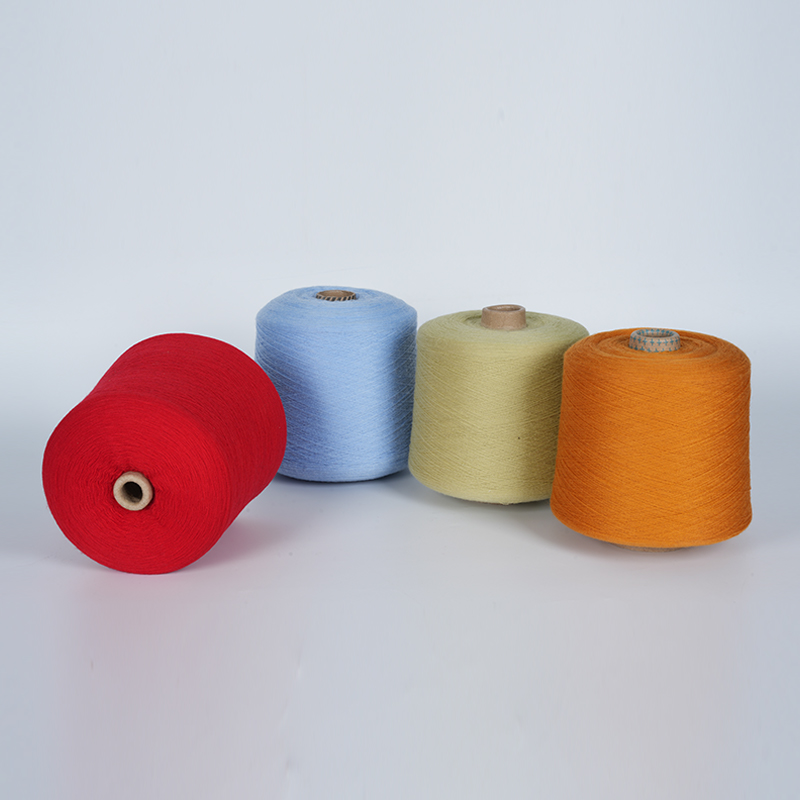
Plant fibers are cellulose-based — composed of the same polysaccharide chains found in plant cell walls. They are generally cooler than animal fibers, more moisture-absorbent, and machine-washable in most cases. They lack the natural elasticity of wool, which makes gauge control more critical and finishing more important.
Cotton is the most widely produced plant fiber in the world. In yarn form, it is durable, washable, hypoallergenic, and highly breathable — making it ideal for warm-weather garments, dishcloths, baby items, and anything that requires frequent laundering. The trade-off is weight and inelasticity: cotton yarn is denser than wool for the same volume and can cause hand fatigue over long knitting sessions. Mercerized cotton — cotton treated with sodium hydroxide under tension — has a rounder fiber profile, improved luster, stronger dye uptake, and slightly better dimensional stability than unmercerized cotton, making it the preferred grade for garments. Unmercerized (matte) cotton is better suited to kitchen and bath accessories where a softer, more absorbent texture is desired.
Linen yarn is spun from the bast fibers of the flax plant. It is stronger than cotton, has excellent heat conductivity (making it one of the coolest fibers to wear in hot weather), and softens significantly with washing and use. Linen yarn is initially stiff and somewhat rough — a characteristic that puts some crafters off — but finished linen fabric and knitwear drapes beautifully after several wash cycles. It is minimally elastic, requiring careful attention to gauge and stitch definition. Linen is also one of the more environmentally favorable plant fibers: flax requires significantly less water than cotton and fewer pesticides to grow.
Hemp yarn is derived from the bast fibers of the cannabis sativa plant. Like linen, it is stronger than cotton and softens with washing, but it starts out coarser and takes longer to break in. Hemp is highly resistant to mold and UV degradation, making it suitable for outdoor and utilitarian applications — bags, baskets, market totes, and macramé. It is one of the most sustainable natural fiber crops: hemp grows rapidly, requires no irrigation in most climates, and improves soil health. Fine-grade hemp yarns have improved significantly in quality and are increasingly found in fashion-forward knitwear collections.
Bamboo yarn is derived from bamboo grass, but the fiber extraction process involves chemical dissolution of the bamboo pulp — technically classifying most bamboo yarn as a semi-synthetic (regenerated cellulose fiber, similar to viscose or rayon) rather than a strictly natural fiber. The resulting yarn is very soft, lustrous, and drapes beautifully, with natural antibacterial properties and good moisture-wicking. However, buyers should be aware that the "natural and eco" marketing often applied to bamboo yarn overstates its environmental credentials relative to truly natural fibers like linen or hemp, given the chemical-intensive manufacturing process involved.
Selecting yarn based on fiber type is most effective when the key properties can be compared across the options relevant to a project. The following table summarizes the most practically important characteristics for crafters.
| Fiber | Warmth | Elasticity | Softness | Washability | Best Use Cases |
|---|---|---|---|---|---|
| Merino Wool | High | High | Very High | Hand wash / superwash grades machine wash | Garments, baby wear, accessories |
| Standard Wool | High | High | Moderate | Hand wash only (felts in machine) | Outerwear, blankets, felting projects |
| Alpaca | Very High | Low | High | Hand wash cold | Accessories, shawls, blankets |
| Cashmere | High | Low–Moderate | Exceptional | Hand wash cold only | Luxury garments, lightweight scarves |
| Silk | Moderate (cool) | Low | High | Hand wash / dry clean | Warm-weather wear, blends, weaving |
| Cotton | Low (cool) | Very Low | Moderate–High | Machine wash safe | Warm-weather garments, baby items, dishcloths |
| Linen | Low (very cool) | Very Low | Moderate (softens with use) | Machine wash (improves with washing) | Summer tops, home textiles, bags |
| Hemp | Low (cool) | Very Low | Low–Moderate | Machine wash safe | Bags, macramé, utilitarian textiles |
Yarn weight (thickness) and ply (number of strands twisted together) are independent variables that together determine how a natural fiber yarn knits up. Confusingly, the terms are often conflated — a "4-ply" yarn in British terminology refers to a lightweight yarn regardless of actual strand count, while in American usage, "ply" describes the construction.
The Craft Yarn Council system classifies yarns from 0 (lace) to 7 (jumbo). For natural fiber yarn, the most commonly used weights are:
A single-ply (singles) yarn is one continuous untwisted or lightly twisted strand. It has a soft, airy quality and shows stitch definition well, but is less durable and more prone to pilling than plied yarns. A 2-ply or 3-ply yarn consists of multiple strands twisted together in the opposite direction to the original spin, producing a more balanced, round yarn with better stitch definition and abrasion resistance. For socks and high-wear items, a 2-ply or 4-ply construction with a small nylon content (10–20%) is significantly more durable than a pure singles natural fiber yarn.
Matching the fiber to the project's functional requirements prevents common frustrations: a beautiful silk sweater that grows out of shape, a linen baby blanket that scratches, or an alpaca hat that no longer fits after one wash. The following guidance is organized by the most common project categories.
Items worn by babies require softness (under 20 microns if wool), hypoallergenic properties, and machine washability. Superwash merino, organic cotton, and bamboo-cotton blends are the most commonly used fibers. Avoid standard (non-superwash) wool for items that will be washed frequently — felting risk is too high. Linen and hemp, while safe and durable, are too firm for newborn skin and better suited for older children's items like bags or sturdy outerwear accessories.
Blending two or more fibers — either natural-to-natural or natural-to-synthetic — allows yarn manufacturers to combine the strengths of each while mitigating their individual weaknesses. Some of the most practical and commercially successful yarns in both the handcraft and textile industries are blends rather than pure single-fiber yarns.
The longevity of any natural fiber item depends almost entirely on how it is washed, dried, and stored. Natural fibers respond very differently to heat, agitation, and chemicals than synthetic yarns, and the most common damage — felting, distortion, pilling, or color loss — is preventable with the right care approach.
Blocking — wetting or steaming a finished piece and pinning or reshaping it to dry — is one of the most transformative steps in natural fiber craft. A blocked wool or silk piece looks professionally finished; an unblocked one often looks amateurish regardless of knitting quality. Natural fibers respond to blocking because the fiber structure relaxes and sets in the moistened state. Lace patterns in particular need aggressive wet blocking to open up and become legible. Synthetic fibers respond poorly or not at all to wet blocking because their structure is fixed by the manufacturing process.
Protein-based natural fibers — wool, cashmere, alpaca, mohair, and silk — are vulnerable to moth larvae (Tineola bisselliella), which feed on the keratin and fibroin protein in the fiber. Plant fibers are not affected. Preventive measures include storing clean wool and other protein fiber garments in sealed bags or cedar-lined boxes, using natural deterrents such as cedar balls, lavender sachets, or cloves in storage areas, and checking stored woolens periodically. Washing garments before storage is critical — moth eggs are most often introduced through unwashed items, and food or body oil residue on the fiber attracts larvae. Commercial moth traps (pheromone-based) are effective monitoring and control tools for yarn stashes and storage.
The natural fiber yarn market includes a wide range of quality and ethical standards, and marketing terms like "natural," "eco," or "organic" are used inconsistently. Several third-party certifications provide meaningful assurance of fiber origin, processing standards, and environmental claims.
Beyond certifications, buying yarn from indie dyers and small mills that disclose their full supply chain — breed, farm, spinning mill, and dye source — provides the most transparency. The closer the buyer is to the source, the more accurately the fiber's provenance can be verified.
 Contact Us
 Products
 Send An E-mail
No. 189 Pengfei Road, Industrial Park, Tudian Town, Tongxiang City, Zhejiang Province, China
 Mobile


 English
 Français
 Español
 عربى
عربى